Tree of Life Iceland: How I Discovered and Named This Aerial Landscape
Tree of Life in Iceland has become one of the most recognizable aerial photography locations in the Icelandic Highlands. Today, photographers travel into this remote volcanic landscape to photograph its extraordinary tree-shaped network of rivers, vegetation and dark volcanic earth.
But my story with the Tree of Life began before the photograph for which it later became known.
I first found and photographed this formation in the summer of 2019, while exploring the Icelandic Highlands with my very first drone, a DJI Mavic Pro.
I wasn't looking for a tree.
I wasn't following somebody else's photograph.
In fact, I had travelled to that part of Iceland to photograph something completely different.
And, strangely enough, the decision that eventually brought me there began with the toss of a coin.
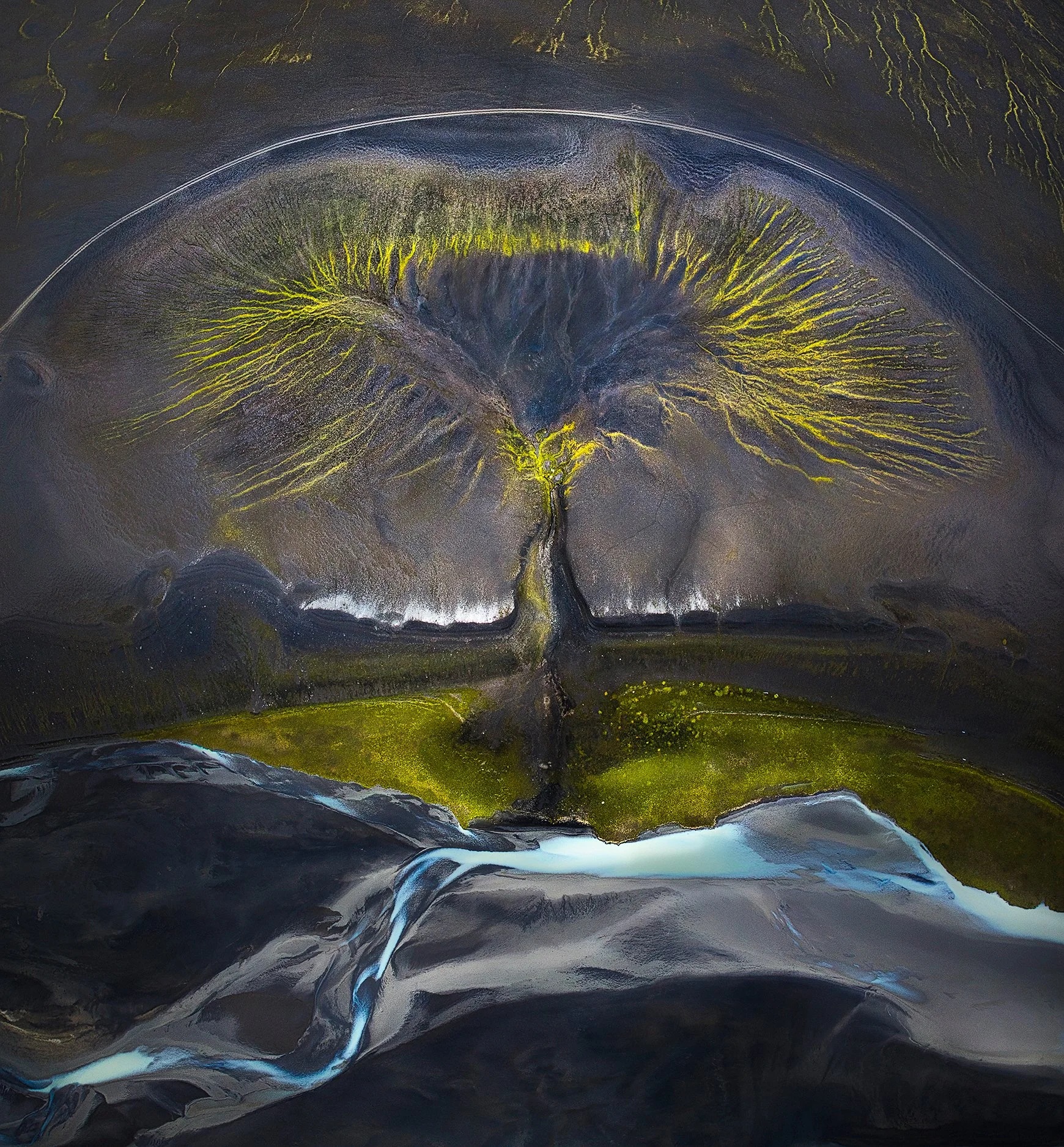
My award winning version of Tree of Life taken in 2023
My first aerial photography trip to Iceland in 2019
In the summer of 2019, I travelled to Iceland with a friend (not a photographer) for a very short trip of roughly one week.
At that point in my photography career, my way of travelling was quite different from today. There were not as many photography workshops to lead and more time dedicated to scouting.
So, we simply rented a 4x4 and went exploring.
Iceland had already fascinated me enormously, but this time I was particularly interested in its remote Highlands. I also had something relatively new with me: my first drone, a DJI Mavic Pro bought in 2017.
Until then, most of my landscape photography had been created from ground level. My style was very different from what it is today. I loved dramatic mountains, immersive wide angle compositions, strong foregrounds, flowers, textures close to the camera and scenes with a very clear sense of depth.
Flying a drone was starting to show me a completely different way of seeing the landscape.
From above, Iceland became something else.
Rivers turned into lines.
Volcanic soil became texture.
Vegetation created patterns.
Landscapes that seemed chaotic from the ground suddenly became incredibly graphic when viewed vertically from the sky.
But at the time, I was still very unsure about this new direction.
When I first photographed what I later called Tree of Life, I immediately felt there was something special in that formation, but I hesitated to publish it. The image was completely different from the kind of work people associated with me at the time, and also from the photographs I personally felt most confident sharing.
There was another reason too. I simply was not happy with the image quality of my first drone. I loved the idea, the pattern and the discovery itself, but technically the files from the Mavic Pro did not give me the quality I wanted for such an important image.
So I kept it.
I looked at it again and again, unsure whether it belonged to my work at all.
Eventually, I left it in the archive.
The photograph stayed there for years, almost like an idea I was not ready to develop yet.
I did not know it at the time, but that hesitation would become an important part of the story. Four years later, with a different photographic vision and a much better drone, I would return to the same place and finally create the image I had always felt was hidden there.
A coin toss changed our plans
Toward the end of our short journey, my friend and I couldn't decide what to do next.
There was another spectacular area of the Icelandic Highlands that I wanted to explore, but it was far away.
Our flight home was approaching — only a couple of days remained — and driving there would mean giving up the possibility of properly exploring the part of the Highlands where we already were.
We kept changing our minds.
Go?
Stay?
Both choices seemed equally tempting.
Eventually, because neither of us could decide, we tossed a coin.
The coin told us to stay.
It seemed completely insignificant at the time.
Looking back now, it was one of those tiny decisions that can unexpectedly change the course of a photographic story.
Because that evening, instead of planning the long drive to another part of Iceland, I opened the maps and began looking closely at the landscape around us.
I was searching for a blue crater lake
While studying satellite imagery, I noticed a fascinating blue crater lake in the Icelandic Highlands.
The shapes surrounding it looked particularly interesting from above, and I immediately thought it could work as an aerial photograph.
That became my destination for the following day.
This is an important part of the story because Tree of Life was not the location I was searching for.
My plan was to photograph the crater.
The following day, we drove our 4x4 into the Highlands and reached the area I had studied the night before.
I took out my Mavic Pro and launched it.
At first, I flew toward the landscape I had originally planned to photograph.
Then, while exploring the surrounding terrain from the air, something caught my attention on the drone screen.
The moment I saw the Tree of Life from above
Close to the area I was photographing, I began noticing strange green shapes running through the dark volcanic terrain.
I flew closer.
Waterways and vegetation were following channels carved into the ground, creating incredible organic patterns that would have been almost impossible to understand from ground level.
From above, however, their shape suddenly became obvious.
They looked like trees.
There was not only one.
Several smaller formations appeared throughout the landscape, almost as if trees were growing across the black volcanic earth.
Then I saw the largest one.
Its central structure opened into an extraordinary network of branches.
Green vegetation followed the waterways through the dark terrain, creating something that looked astonishingly similar to an enormous tree viewed from directly above.
I immediately knew what I wanted to call it.
Tree of Life.
Why I named it Tree of Life
The name came naturally to me the first time I saw the formation from the air in 2019.
The contrast was what fascinated me most.
The surrounding volcanic terrain looked dark and almost lifeless, while this vivid green structure seemed to spread through it like a living organism.
Water flowed through the landscape and vegetation followed its path, creating the appearance of branches, roots and veins.
It looked like life emerging from the earth.
That is why I called it Tree of Life.
I first photographed the formation in 2019 with my DJI Mavic Pro, and Tree of Life was the name I gave it during that first encounter.
To the best of my knowledge, I was also the first photographer to photograph this exact formation.
At the time, however, I could never have imagined what would happen to this place in the following years.
For me, it was simply something extraordinary I had discovered while exploring Iceland with my first drone.
Why I did not publish Tree of Life in 2019
Even though I immediately felt that there was something special about the formation, I was extremely unsure about publishing the photograph.
There were two main reasons.
The first was technical.
I simply was not satisfied with the image quality I was getting from my first DJI Mavic Pro.
I loved the shape.
I loved the idea.
I loved what I had discovered.
But when I looked at the file, I did not feel that the technical quality was good enough for the photograph I imagined in my mind.
The second reason was probably even more important.
The photograph felt completely different from my photographic style at the time.
In 2019, people mostly knew my work for dramatic mountain landscapes photographed from the ground.
I loved flowers in the foreground, immersive perspectives, dramatic skies, strong depth and the visual impact created by photographing very close to foreground elements.
Tree of Life had almost none of those characteristics.
It was flat.
It was abstract.
There was no foreground.
There was no mountain.
There was no conventional sense of perspective.
It was completely different from what I was used to creating and, at the time, I was not sure whether that kind of photograph even belonged in my portfolio.
I kept going back to the image.
Sometimes I loved it.
Sometimes I wondered whether it was simply too different from everything else I was creating.
Eventually, I decided not to publish it.
I left the photograph in my archive.
And it stayed there for almost four years.
But I never really forgot it.
Why I returned to Tree of Life in 2023
By 2023, both drone technology and my own photographic vision had changed considerably.
Over those four years, I had become increasingly fascinated by aerial photography and especially by abstract landscapes.
I started looking for relationships between shapes, textures and colors.
I became interested in photographs where viewers could not immediately understand the scale of what they were seeing.
Aerial photography was no longer simply something I experimented with during my travels.
It was becoming another important way for me to interpret the landscape.
At the same time, drone technology had improved dramatically.
I had started using the DJI Mavic 3 Pro, and the difference in image quality gave me much more freedom.
For the first time, I felt that I had a drone capable of producing the kind of file I wanted for my photography.
And one old image immediately came back into my mind.
The strange tree I had photographed in Iceland four years earlier.
Returning to the Icelandic Highlands in 2023
In August 2023, between a trip to Greenland and photography work I had in Iceland, I decided to return to the location.
This time everything was different.
In 2019, finding Tree of Life had been completely unexpected.
In 2023, I knew exactly what I was looking for.
The formation had remained in my mind for four years.
I returned to the area with my DJI Mavic 3 Pro and launched the drone above the same landscape.
And there it was.
The enormous natural tree was still spreading across the dark Icelandic terrain.
But this time I was not simply exploring.
I wanted to create the photograph I had imagined for years.
Creating the final Tree of Life photograph
I began working carefully on the composition.
I wanted the main tree to dominate the photograph while still leaving enough of the surrounding landscape visible to create a sense of mystery.
I wanted viewers to look at the image for a moment before understanding exactly what they were seeing.
The green and yellow vegetation followed the branching channels.
A pale blue river curved through the landscape.
The dark volcanic ground became almost like a black canvas surrounding the main subject.
Seen vertically from above, the landscape stopped looking like a conventional Icelandic landscape.
It looked alive.
Like a tree.
Like veins.
Like a nervous system.
Like something suspended between geology and biology.
That was when I created the photograph that became internationally known as Tree of Life.
Tree of Life Iceland in 2023
Tree of Life photographed by Isabella Tabacchi in the Icelandic Highlands in August 2023 with the DJI Mavic 3 Pro.
The distinction between these two moments is very important to me.
2019 was when I first found the formation, photographed it and named it Tree of Life.
2023 was when I returned and created the final photograph that later became internationally recognized.
How Tree of Life became an iconic aerial photography location in Iceland
After returning from Iceland in 2023, I finally published the photograph.
I used the same name that had been in my mind since the first time I saw the formation four years earlier.
Tree of Life.
Then something happened that I had never expected.
The photograph began circulating online.
People shared it.
Photography pages featured it.
The image started reaching people far beyond the audience that normally followed my photography.
Eventually, I began seeing other photographers travelling into the Icelandic Highlands to find the same formation and create their own interpretations of it.
A location that I had discovered almost accidentally while flying my first drone in 2019 gradually became a recognizable aerial photography location in Iceland.
And the name Tree of Life began travelling together with the place.
Watching this happen has always fascinated me.
A landscape can exist for thousands of years without having a particular visual identity.
Then somebody photographs it from a certain perspective.
The image gives the landscape a composition.
A name.
A story.
Other photographers see it, travel there and reinterpret it.
Eventually, the place develops another life through photography.
That is exactly what happened with Tree of Life.
Tree of Life photography awards
After seeing the reaction to the photograph, I decided to submit Tree of Life to some of the most important international photography competitions.
The response went far beyond anything I had expected.
Tree of Life received 3rd Place at the International Landscape Photographer of the Year 2023.
You can see the official competition results on the International Landscape Photographer of the Year website.
In 2024, Tree of Life won 1st Place in Nature Aerial and Drone at the International Photography Awards.
You can see the official results in the International Photography Awards 2024 book.
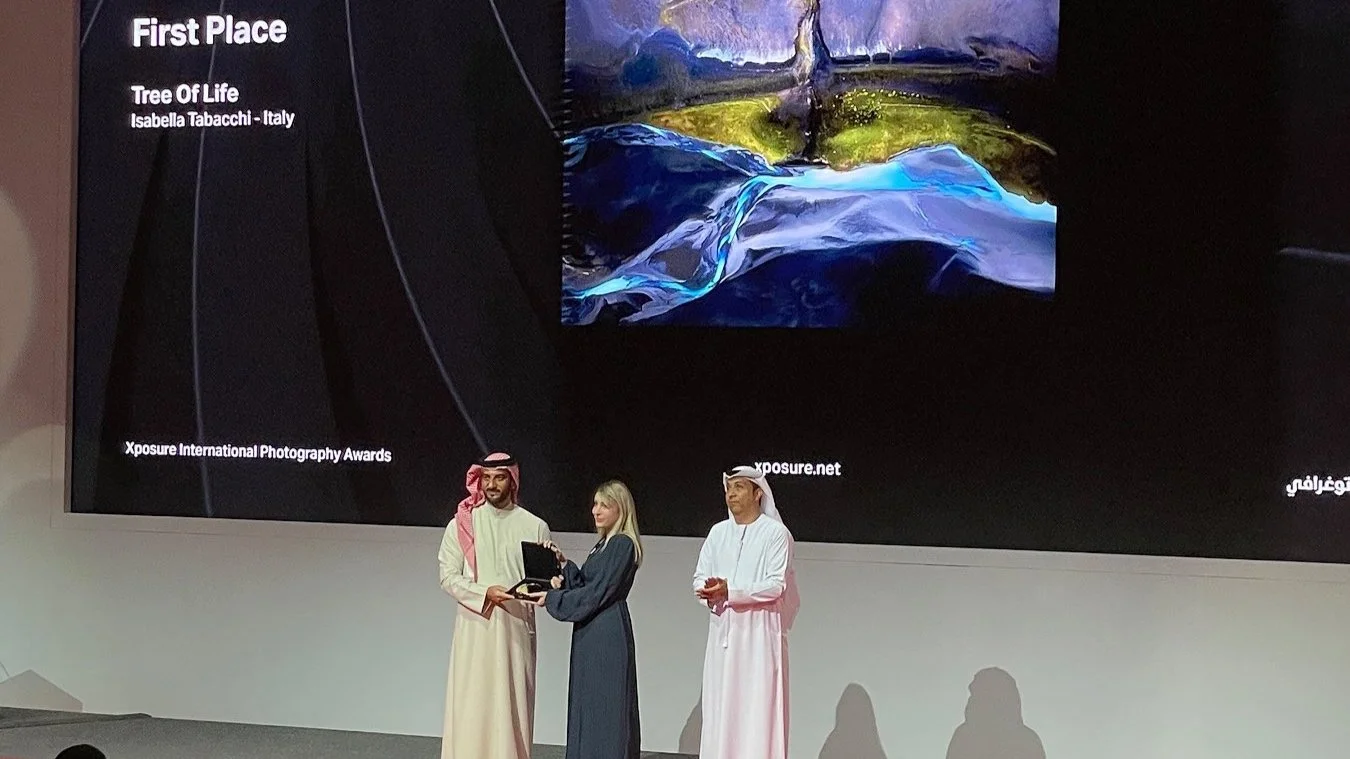
The photograph also received recognition at the Xposure International Photography Awards 2024.
My official photographer profile and award information can be found on the Xposure website.
Tree of Life was also selected among the Top 10 Annual Photos in the 9th DJI SkyPixel Annual Contest.
It later won 1st Place in the Abstract category at the Drone Photo Awards.
The winning photograph can be seen in the official Drone Photo Awards gallery.
The Tree of Life series also received 1st Place in Professional Landscape at the Fine Art Photography Awards.
You can see the winning project in the official Fine Art Photography Awards gallery.
The series also received 1st Place and the Gold Star Award in Professional Drone Photography at the ND Awards 2025.
Tree of Life was also published in the November 2024 issue of National Geographic.
When I think about all these awards and publications, what still amazes me most is where the story began.
With a photograph that had remained hidden on my hard drive for years.
From my first DJI Mavic Pro to one of my most important photographs
When I look at the original Tree of Life file from 2019 today, I do not simply see an old drone photograph.
I see the beginning of something.
At the time, I did not yet have the aerial photographic vision that I developed later.
I did not have the DJI Mavic 3 Pro.
I did not know the image would eventually win international photography awards.
I certainly did not know that other photographers would travel to Iceland to search for the same formation.
I had simply looked at the screen of my first drone and noticed something extraordinary hidden inside the landscape.
That moment is also one of the reasons why exploration remains such an important part of photography for me.
Photography is not only about arriving at famous locations and creating another interpretation of something we already know.
Sometimes it is about travelling without knowing exactly what you are going to find.
Sometimes it is about curiosity.
Sometimes it is about looking at a landscape from a completely different perspective.
And sometimes it is simply about being in the right place because a coin told you to stay.
The coin that led me to Tree of Life
When I think about this photograph today, I often think about that coin.
Had it landed on the other side, my friend and I might have driven to a completely different part of the Icelandic Highlands.
I probably would not have spent that evening exploring Google Maps.
I would not have chosen the blue crater as our destination.
I might never have launched my first drone from that particular area.
And perhaps I would never have seen the enormous natural tree hidden in the landscape beside it.
Eventually somebody else might have found it.
But that is not what happened in my story.
I found it in the summer of 2019.
I photographed it with my first drone.
I looked at its branches and named it Tree of Life.
Then I kept the photograph in my archive for four years because I was unsure about its technical quality and because it felt so different from everything I was creating at the time.
In 2023, I finally returned with a better drone and a different photographic vision.
And I created the photograph that had been waiting in my mind since that first flight.
Sometimes a photograph takes a fraction of a second to create.
Sometimes it takes four years and the toss of a coin.
For me, that is the story of Tree of Life in Iceland.
Frequently Asked Questions about Tree of Life in Iceland
What is Tree of Life in Iceland?
Tree of Life is the name I gave to a natural formation in the Icelandic Highlands where waterways and vegetation create the appearance of a giant tree when viewed vertically from the air.
Who named Tree of Life in Iceland?
I named the formation Tree of Life after first photographing it during a drone flight in the Icelandic Highlands in 2019.
The name was inspired by the way the green vegetation and waterways appeared to create branches spreading through the dark volcanic landscape.
When did Isabella Tabacchi first photograph Tree of Life?
I first photographed Tree of Life in 2019 with my first drone, a DJI Mavic Pro.
I returned to the same location in August 2023 with a DJI Mavic 3 Pro to create the final photograph that later became internationally recognized.
Was Tree of Life photographed in 2019 or 2023?
Both dates are part of the story.
I first found, photographed and named the formation Tree of Life in 2019.
The final award winning photograph was created when I returned to the location in 2023.
Why did Isabella Tabacchi not publish Tree of Life in 2019?
At the time, I was not satisfied with the image quality produced by my first DJI Mavic Pro.
The photograph was also completely different from my usual photographic style in 2019, which was strongly based on dramatic landscapes, flowers, foreground elements and immersive perspectives.
I was very unsure about the image, so I decided to keep it in my archive.
What drone did Isabella Tabacchi use to photograph Tree of Life?
I first photographed Tree of Life in 2019 using a DJI Mavic Pro.
I created the final 2023 photograph using a DJI Mavic 3 Pro.
Why is the photograph called Tree of Life?
I chose the name because the vegetation and waterways create an enormous tree shaped structure when viewed from above.
Against the dark volcanic landscape, the green branches reminded me of life spreading through an apparently lifeless environment.
Where is Tree of Life located?
Tree of Life is located in the remote Icelandic Highlands, surrounded by volcanic terrain, waterways and areas of green vegetation.
